Year: 2026

  • APC Stakeholder Protests Alleged Secret Compilation of Umon North Ward Executive List

    APC Stakeholder Protests Alleged Secret Compilation of Umon North Ward Executive List

    By BANNERNEWS Reporter

    A stakeholder of the All Progressives Congress (APC) in Umon North Ward, Biase Local Government Area of Cross River State, Engr. Egan Adat Okon-Effiong, has formally rejected the alleged compilation of a new ward executive committee list, describing the process as secretive and unconstitutional.

    Okon-Effiong, in a letter dated February 19, 2026, and addressed to the APC State Chairman, with a copy to the Biase Local Government Council Chairman, claimed the list was reportedly drafted in a private residence without consultation with duly recognised ward stakeholders.

    She alleged that a small group of individuals privately assembled and unilaterally prepared what they presented as a leadership list for the ward, warning that such action undermines democratic norms and violates the party’s constitution.

    According to her, key ward figures and statutory stakeholders were excluded from the alleged process, including the Deputy Ward Leader, the Commissioner for Humanitarian Affairs, and the councillor representing Umon North Ward, as well as other recognised party leaders.

    She further stated that she was neither informed nor invited to any meeting where such decisions were taken, stressing that no transparent congress or properly convened stakeholders’ forum was held to legitimise the exercise.

    The APC stakeholder argued that the alleged action constitutes a breach of internal party democracy and contradicts provisions of the party’s constitution, which emphasise transparency, inclusiveness, and due process in the formation of ward executive committees.

    Okon-Effiong warned that excluding stakeholders from leadership decisions could weaken grassroots mobilisation, create internal divisions, and damage the party’s credibility among members and the electorate.

    She maintained that party leadership must emerge through constitutionally recognised procedures, involving statutory officers and stakeholders, rather than through what he described as selective consultations held in private settings.

    The stakeholder called on the party leadership to clarify the circumstances surrounding the alleged list, disclose those involved in its compilation, suspend any attempt to implement it, and convene a properly constituted stakeholders’ meeting in line with the party’s guidelines.

    She emphasised that her objection was not driven by personal interest but by the need to protect internal democracy, transparency, and unity within the party, insisting that leadership legitimacy must be earned through due process and broad-based participation.


  • Armed Men Disrupt SSANU Election at UNICAL, Union Alleges Interference

    Armed Men Disrupt SSANU Election at UNICAL, Union Alleges Interference

    By BANNERNEWS Reporter

    The quadrennial congress and election of the Senior Staff Association of Nigerian Universities (SSANU) at the University of Calabar were disrupted on Thursday after armed men reportedly invaded the venue, forcing a halt to proceedings.

    National officers of the union, led by Deputy National President, Comrade Leku Ador, were in Calabar to supervise the exercise, which is held every four years to review the performance of branch executives and elect new officers.

    Other members of the delegation included National Vice-President (South-South), Comrade Cheta Azuma; National Treasurer, Comrade Uchenna Nwokeji; and National Trustee, Comrade Monday Izu. The officials had earlier paid a courtesy visit to Vice-Chancellor, Prof. Offiong Offiong, to formally notify the university management of their presence and mission.

    University sources said the Vice-Chancellor was unavailable at the time and was represented by a Deputy Vice-Chancellor. The union delegation was reportedly informed that although approval had been granted for the congress, clearance for the venue was still under consideration due to security concerns.

    According to SSANU officials, the Deputy Vice-Chancellor cited unspecified intelligence reports suggesting the possibility of disruption and requested the national officers to sign an undertaking accepting responsibility for any security incidents. The union leaders declined the request and proceeded to the congress venue.

    Union members had already assembled when the national officers arrived, and the gathering began peacefully. However, the meeting was interrupted when armed men entered the venue and instructed members to stop the exercise, citing security reasons.

    The incident caused panic among some members, although no injuries were reported. Union officials said they continued consultations and resolved to extend the tenure of the existing executive by three months, in line with constitutional provisions, pending a fresh election.

    SSANU officials expressed concern over the disruption and called for an environment that allows unions to conduct their internal processes without hindrance. They maintained that the union remained committed to due process and peaceful engagement.

    Reacting to the incident, the university’s Public Relations Officer, Mr Eyo Effiong, denied allegations that armed thugs were deployed to disrupt the congress. He said those present were regular university security personnel assigned to maintain order and ensure safety on campus.

    The development has drawn attention to labour-management relations within the institution, with observers calling for dialogue between university authorities and union leaders to prevent further tension and ensure stability in the academic environment.

  • OPINION: Between Competing Mandates -The Uncertain Place in Rivers Loyalists

    OPINION: Between Competing Mandates -The Uncertain Place in Rivers Loyalists

    By Justice Osai Ahiakwo

    Between the political mandate of President Bola Tinubu and the entrenched influence of Nyesom Wike lies a pressing question: Where do Rivers loyalists truly stand?

    The political terrain in Rivers State is no longer defined solely by local alliances or state-level calculations.

    It has evolved into a contest shaped by national power dynamics, strategic positioning, and legislative maneuvering.

    In this shifting landscape, loyalty is being tested, recalibrated, and, in some cases, redefined.

    The coming into force of the 2026 Electoral Act was widely challenged as Section 60 was crafted with intent to manipulate election results.

    This has defeated the true purpose of electronic transition, a milestone intended by the repelled 2022 Electoral Act that seeks to strengthen transparency, accountability, and credibility in Nigeria’s electoral process.

    The original concept was to introduce mechanisms designed to reduce manipulation and improve public confidence in elections.

    Conversely, electoral laws do not operate in isolation from political actors.

    Their effectiveness depends on the integrity of those who interpret and implement them.

    Where political interests dominate institutional safeguards, even well-crafted legislation can be repurposed to serve narrower objectives.

    The release of the 2027 general election timetable by the Independent National Electoral Commission (INEC) signaled the formal commencement of political calculations toward the next electoral cycle.

    Electoral timetables are not mere administrative notices; they shape party primaries, coalition-building, and campaign strategies.

    Yet, the proximity between the release of the timetable and subsequent amendments to the electoral framework raises legitimate concerns.

    When the legal architecture governing elections is altered shortly after timelines are published, it inevitably invites scrutiny regarding motive and impact.

    Amendments to electoral laws are not inherently problematic.

    As democracies evolve, legal frameworks must sometimes be adjusted to address gaps or emerging realities.

    However, drastic or hurried amendments risk destabilizing the status quo and generating perceptions of manipulation.

    Stability in electoral rules is essential to maintaining trust.

    When stakeholders suspect that rules are being recalibrated to favor certain interests ahead of 2027, confidence in the neutrality of the process weakens.

    Within this broader national context, Rivers State occupies a sensitive position.

    Historically marked by intense political rivalry and factional alignments, the state has long grappled with the influence of godfatherism and strongman politics.

    What appears to be changing, evidently, is not the disappearance of these forces relocated.

    The arena of contests is shifting from the state platform to the national stage.

    Political control is no longer exercised solely through local patronage networks; it is increasingly tied to alignment with federal authority, as was the introduction of local government autonomy, creating direct links to the federal government.

    This centralization of political power reshapes loyalty structures.

    Rivers loyalists, particularly those who align with either Tinubu’s national mandate or Wike’s entrenched political influence, must now navigate a more complex terrain.

    Allegiance is no longer simply about state-level solidarity.

    It is intertwined with federal appointments, party machinery, and national calculations.

    In this environment, loyalty risks become transactional rather than ideological.

    The tension between federal influence and state autonomy is not new in Nigerian politics.

    Political actors consolidate influence at the national level by altering the balance within federating units.

    Decisions affecting Rivers and other APC States may increasingly be influenced by considerations external to the state’s immediate interests. For loyalists on the ground, this creates uncertainty:

    Are they defending local mandates, or are they instruments in a broader national chess game?

    Godfatherism and political gangsterism, though often criticized, have traditionally operated within defined state boundaries routinely controlled by some former and sitting governors.

    Their shift toward national coordination suggests a more sophisticated consolidation of power.

    Political survival now depends not only on local dominance but also on strategic proximity to central authority.

    This transformation does not eliminate strongman politics who now is in charge of the national government. It indeed has elevated it.

    For Rivers citizens and political stakeholders, the critical issue is accountability.

    When political influence becomes centralized, it can weaken grassroots participation and diminish local voices.

    Loyalists may find themselves defending positions that reflect national strategies rather than community priorities.

    The danger lies in the erosion of democratic responsiveness to grassroots, where political allegiance overshadows public interest.

    In the coming 2027 general elections, the interplay between legal reforms, national mandates, and state-level dynamics will define the political direction of Rivers State.

    The question remains whether electoral processes will strengthen democratic competition or entrench centralized control.

    Therefore, Rivers loyalists must confront a fundamental choice: align uncritically with power wherever it resides or insist that political mandates, whether national or state, remain accountable to the people.

    The shifting ground of Nigerian politics reflects a broader struggle between institutional integrity and strategic power consolidation.

    Where Rivers loyalists stand will depend on whether they prioritize loyalty to individuals or commitment to democratic principles, a decision that will determine not only political outcomes in 2027 but also the credibility of governance in Rivers State and by extension the Nigeria state.



  • Not in good frame of mind to speak about my husband’s arrest – Obono-Obla’s wife tells journalists 

    Not in good frame of mind to speak about my husband’s arrest – Obono-Obla’s wife tells journalists 

    By BANNERNEWS Reporter
    The wife of social critic and lawyer, Mrs Justina Obono-Obla has told journalists that she was not in the good frame of mind to talk about the arrest of Barrister Okoi Obono-Obla.
    Obono-Obla, a former presidential aide to President Muhammadu Buhari was whisked away from his home in Ijiman community where he is a traditional ruler on Thursday morning.
    She however volunteered that his arrest may be connected with a petition, stating that her concentration first was to have him taken on bail.
     Ijiman youths have been agitated over his arrest since Thursday morning, demanding to know his whereabouts and what led to his arrest.
    But one Mr Iwara Michael, a social media user stated that Obono-Obla was arrested by security agencies led by a Deputy Commissioner of Police.
    But PRO of the state Police command, Eitiokpa Sunday Akata denied knowledge of the arrest.
    In an interview, chairman of Nigeran Bar Association, NBA, in Calabar, Enome J. amatey, Esq said they did not know which agency of government or who whisked their senior colleague away.
     Amatey said, “We’ve heard about his arrest. Unfortunately, we don’t know which agency arrested him. The circumstances are hazy.
    “We only hope for the best, and that his rights will be respected. We hope that he’ll be given fair opportunity to defend himself, access to fair representation.
    “We hope that he’s not held unjustly beyond constitutionally allowed period.”
    He assured that NBA will get full briefing of the facts surrounding his arrest. We’ll ascertain which agency arrested him. If need be, we’ll cause members of our human rights committee to wade into it.”
    There are suspicions that his arrest may be politically motivated, given the fact that Obono-Obla has been social activist and political critic.
  • 700 Journalists, 89 Observer Groups To Cover FCT Poll

    700 Journalists, 89 Observer Groups To Cover FCT Poll

    By BANNERNEWS Reporter
    The Chairman of the Independent National Electoral Commission (INEC), Prof. Joash Amupitan (SAN), says the commission has concluded preparations for the 2026 Federal Capital Territory (FCT) Area Council elections scheduled for Saturday, February 21.
    Speaking at a stakeholders’ meeting in Abuja on Wednesday, Amupitan said 1,680,315 registered voters will participate in the poll across 2,822 polling units in the six area councils of Abaji, Abuja Municipal Area Council, Bwari, Gwagwalada, Kuje and Kwali.
    He added that 570 candidates are contesting 68 constituencies, covering chairmanship, vice-chairmanship and 62 councillorship seats.
    He described the FCT poll as the only local government election conducted by INEC, noting that it has become a benchmark for polls conducted by State Independent Electoral Commissions and strengthened confidence in grassroots democracy.
    Amupitan said INEC has implemented all activities in its 13-item timetable, with only the close of campaigns at midnight on Thursday, February 19, and Election Day remaining. He urged political parties and candidates to comply strictly with electoral laws.
    On voter readiness, he disclosed that distribution of Permanent Voter Cards (PVCs) ended on February 10, with 106,099 cards collected during the Continuous Voter Registration exercise. He encouraged eligible voters to turn out peacefully and exercise their franchise.
    The INEC chairman said 89 domestic and foreign observer groups and 700 journalists from 72 media organisations have been accredited to monitor and cover the election, while 11,873 polling unit officials will be deployed alongside supervisory and technical personnel.
    He added that the Bimodal Voter Accreditation System (BVAS) has been upgraded and will be deployed in all polling units, with results uploaded to the INEC Result Viewing Portal. He noted that all devices, including backup units, have been tested, while a mock accreditation exercise in 289 polling units produced satisfactory results.
    To ensure seamless logistics, INEC will deploy 1,132 vehicles, 620 motorcycles and 14 boats, with polling units expected to open at 8:30 a.m.
    He also reaffirmed the commission’s neutrality and warned against vote trading, saying the Economic and Financial Crimes Commission (EFCC) and the Independent Corrupt Practices and Other Related Offences Commission (ICPC) will deploy personnel to arrest offenders.
    Amupitan urged security agencies, political parties and voters to act responsibly, stressing that INEC’s mandate is to ensure votes are cast freely, counted accurately and reflected transparently.
  • Carbon Monoxide Leak Kills 38 Miners In Plateau 

    Carbon Monoxide Leak Kills 38 Miners In Plateau 

    By BANNERNEWS Reporter
    No fewer than 38 miners have died following a carbon monoxide leak at a mining site in Kampani Zurak community, Wase Local Government Area of Plateau State.
    The tragic incident occurred in the early hours of Wednesday while the miners had returned to the site after observing their morning prayers.
    A local miner, Safiyanu Haruna, who confirmed the incident, said more than 20 other miners sustained injuries and were rushed to a hospital in Wase town for treatment.


    Haruna explained that the victims had temporarily left the mining site around dawn for prayers but were overcome by the toxic gas shortly after they returned.
    “It was carbon monoxide gas that leaked and killed them. Around 5:30 am, they were alive when they left for prayers. When they returned, they were found in that condition,” he said.
    He added that the absence of early responders worsened the situation, as those scheduled to resume work later in the morning had not yet arrived to initiate rescue efforts.
    According to him, funeral prayers for the deceased miners were already underway in the community amid widespread grief.
    As of the time of filing this report, authorities had yet to issue an official statement on the incident.
    However, residents said the chairman of Wase Local Government Area was present at the funeral prayers in solidarity with the bereaved families and the community.

  • Police interface with Cross River Stakeholders Over Alleged AK-47 Threats by Herders

    Police interface with Cross River Stakeholders Over Alleged AK-47 Threats by Herders

    By BANNERNEWS Reporter

    Commissioner of Police, Rashid Afegbua has directed the Divisional Police Officer (DPO) in Odukpani to convene a stakeholders’ meeting to address the allegations that armed herders have been using AK-47 rifles to intimidate farmers whose crops were destroyed by grazing cattle.
    Traditional rulers and community leaders present included HRH Edet Nyong Edet, Clan Head of Ndon; Etetim Etim Ekpo, Village Head of Esit Ikot Ndon; Okon Edet Okon, Village Head of Obot Obio Inwang; and Asuquo Asuquo Okon, Village Head of Calabar River. Youth leaders, women representatives, and Prince Okon, Special Adviser to the Odukpani LGA Chairman, also attended.
    During the meeting, the DPO directed clan heads to produce concerned parties over allegations that Hon. Ukpong Edet Godwin Edet collected ₦4 million from cattle rearers to permit grazing in the affected areas. As of press time, the directive had not been complied with.
    Community representatives complained of repeated destruction of farms by cattle, saying the situation had caused anger and tension among farmers.
    The allegations gained wider attention after callers to a community engagement programme on HIT FM Calabar last week claimed herders threatened farmers with AK-47 rifles when confronted.
    However, the Chairman of Cattle Rearers in Cross River State, Alhaji Bakare Sambo, denied the claims, insisting his members were not involved in armed intimidation.
     He also explained why herders were unable to comply with earlier directives from Odukpani Local Government authorities.
    Meanwhile, the Security Adviser to Governor Bassey Otu for the Southern Senatorial District, Patrick Odiong, criticised media reports on the issue, questioning the credibility of the information.
    Odiong said preliminary inquiries in Okoyong communities did not confirm the alleged incidents and cautioned journalists against relying on hearsay or unverified social media reports.
  • Bayelsa Politician Plays Host to Olumba’s Emissaries

    Bayelsa Politician Plays Host to Olumba’s Emissaries

    By BANNERNEWS Reporter
    A Bayelsa political leader, Chubby Ben Walson, has received emissaries from Olumba Olumba Obu, spiritual head of the Brotherhood of the Cross and Star, at his country home in Bayelsa State.
    The delegation said the visit formed part of global sensitisation activities ahead of the spiritual leader’s silver jubilee celebration, scheduled for April 13 to 19, 2026, in Calabar, capital of Cross River State. The event is expected to draw followers and dignitaries from across the world.
    According to the organisation, the emissaries also conveyed appreciation to Walson for his infrastructural and philanthropic support to the fold in Bayelsa, particularly ongoing projects aimed at strengthening its presence in the state.
    BANNERNEWS gathered that Walson, a two-time Mayor of Yenagoa Local Government Area, is funding the construction of a cathedral in Onopa community. The delegation, led by Patriarch Christ Shepherd Innocent Omini, inspected the project and commended his commitment to the church.
    Speaking during the visit, Walson described the recognition as a rare honour, saying the spiritual leader’s decision to send emissaries to him was a blessing to his household and a reaffirmation of his faith.


    An Archbishop in the organisation, Natus Zekabeme, praised Walson’s devotion, noting that the multi-million-naira cathedral project and solar lighting installations across worship centres in Yenagoa reflected his dedication to God’s work.
    Similarly, the state administrator of the fold, Archbishop Roland Omangi, described the politician’s contributions as significant investments in spiritual growth and community development.
    Delivering the spiritual leader’s message, Omini likened the visit to the biblical encounter between Zacchaeus and Jesus, symbolising grace and transformation, and assured Walson and his household of divine blessings.

  • DPO Shot Dead Whilst Rescuing Stolen Livestock

    DPO Shot Dead Whilst Rescuing Stolen Livestock

    By BANNERNEWS Reporter

    Tragedy struck in Katsina State as the Divisional Police Officer (DPO) of Rimi Division was shot dead while leading an operation to recover stolen livestock and repel suspected bandits in Yanunku village, Charanci Local Government Area.

    The officer, whose identity had not been officially released as of press time, reportedly acted on a distress call from residents who sighted armed men herding rustled cattle through their communities.

    The incident began in Majen Gobir village of Rimi LGA when locals raised alarm over suspicious gunmen moving livestock. Security operatives were alerted, prompting a swift response that turned into a pursuit across neighbouring communities.

    The suspects reportedly moved from Majen Gobir to Magaje village before heading towards Yanunku, with a joint team of police and military personnel tracking them.

    The confrontation at Yanunku turned deadly. In the ensuing gun battle, the DPO was fatally shot. One police officer sustained a gunshot wound to the hand, while three other persons were critically injured and rushed to hospital for treatment.

    Despite the loss, the security team recovered all the stolen animals and neutralised three suspected bandits during the operation.

    Spokesperson of the Katsina State Police Command, DSP Sadik Aliyu, confirmed the incident, stating that the armed men had earlier attacked Magaje village, firing sporadically before fleeing with livestock. He described the DPO’s death as regrettable and said the injured officer is responding to treatment.

    Chairman of Rimi LGA, Muhammad Ali, described the development as a painful loss, noting that the area had enjoyed relative peace in recent months. Residents also paid tribute to the late officer, recalling his hands-on approach and willingness to lead operations personally.

    The Commissioner of Police, CP Bello Shehu, commended the bravery of the joint security team and extended condolences to the family of the fallen officer, describing him as professional and courageous. The killing has renewed concerns over banditry in parts of the state, underscoring the risks faced daily by security personnel.

  • Flames Return to Singer Market, Traders Watch Helplessly as Shops Burn Again

    Flames Return to Singer Market, Traders Watch Helplessly as Shops Burn Again

    By BANNERNEWS Reporter

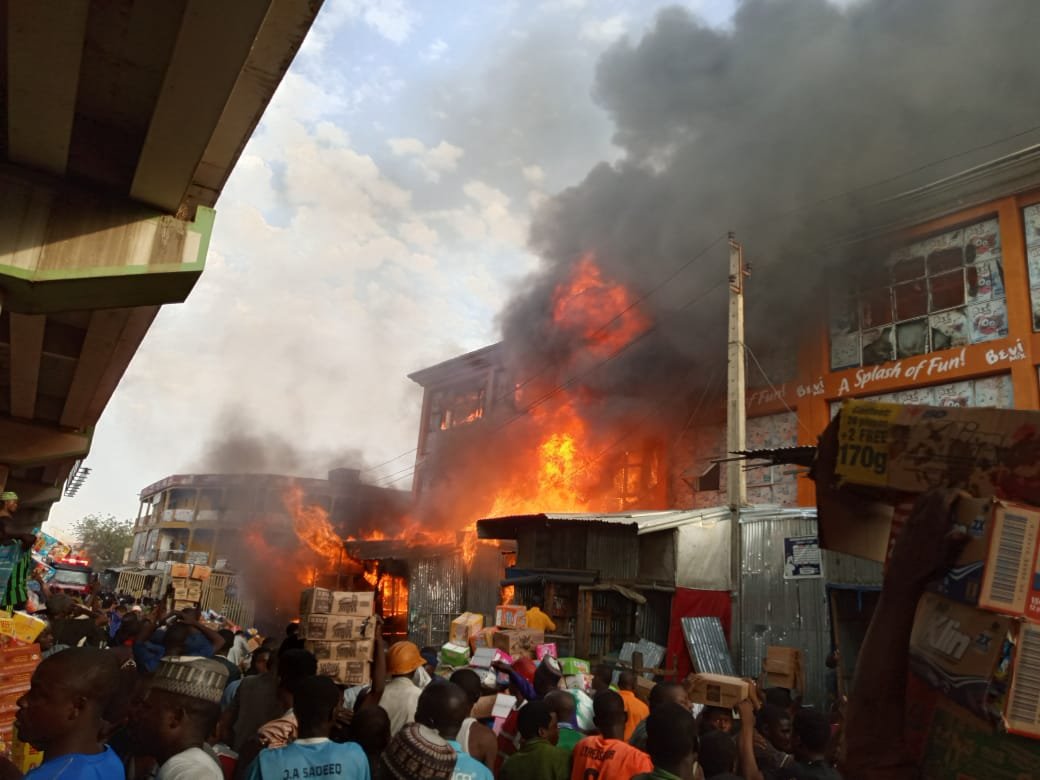
    Fresh anguish swept through Singer Market in Kano on Saturday after another devastating fire outbreak tore through sections of the bustling commercial hub, destroying shops and goods.
    The fire, which erupted in the Gidan Glass section along Ado Bayero Road near Murtala Muhammad Way, marks the second inferno to hit the market in less than two weeks, deepening fears and losses among already shaken traders.
    Eyewitnesses said the blaze began around 4:00 p.m., spreading rapidly through the affected structures and consuming a two-storey building filled with merchandise.
    A trader, Nasir Maharazu, who watched helplessly as the flames raged, described the scene as heartbreaking and worse than the previous incident.
    “As I speak to you now, the fire is still burning. The whole two-storey building is under fire. This one is even worse than the one recorded less than two weeks ago,” he said.
    At the time of filing this report, response efforts appeared stretched, with only one fire service vehicle seen battling the stubborn flames.
    Singer Market, regarded as the largest commodity market in Kano and northern Nigeria, serves as a major supply hub for foodstuff and provisions across northern states and neighbouring West and Central African countries.
    Saturday’s renewed destruction has left many traders counting fresh losses, with uncertainty and grief hanging heavily over one of the region’s most vital economic centres.