Year: 2026

  • NPC Commissioner Ukam Hails Nigeria’s 27 Years of Democracy

    NPC Commissioner Ukam Hails Nigeria’s 27 Years of Democracy

    By BANNERNEWS Reporter, Calabar

    The Federal Commissioner of the National Population Commission (NPC) in Cross River State, Barr. Alex Ukam, has congratulated Nigerians and the people of Cross River State on the country’s 27 years of uninterrupted democratic governance.

    In a Democracy Day message on Friday, Ukam described the nation’s democratic journey since 1999 as one marked by challenges and significant achievements, noting that democracy remains the most credible system of government because it allows citizens to freely choose their leaders.

    He said the gains recorded under democratic rule have been substantial and far-reaching despite the difficulties encountered along the way.

    The NPC commissioner commended the Executive, Legislative and Judicial arms of government for their collective contributions to sustaining democratic governance in Nigeria over the past 27 years.

    Ukam also lauded President Bola Ahmed Tinubu and Cross River State Governor, Senator Bassey Edet Otu, for what he described as their uncommon efforts in strengthening democratic institutions and promoting good governance.

    While celebrating the milestone, he urged citizens to reflect on actions and inactions that could threaten the nation’s democratic foundations.

    According to him, Nigerians have a collective responsibility to nurture, strengthen and protect democracy for the benefit of present and future generations.

    He called on citizens to remain committed to preserving the country’s democratic heritage and to act as builders rather than destroyers of the system.

    Ukam wished Nigerians and the people of Cross River State a happy Democracy Day celebration and reaffirmed the need for continued support for democratic ideals and institutions.


  • FG Urged To Invest in Marine Science To Unlock Blue Economic Potential

    FG Urged To Invest in Marine Science To Unlock Blue Economic Potential

    Eyo Charles, Calabar

    The Federal Government has been urged to invest heavily in marine science and ocean resource development to unlock the vast economic opportunities embedded in Nigeria’s maritime sector.

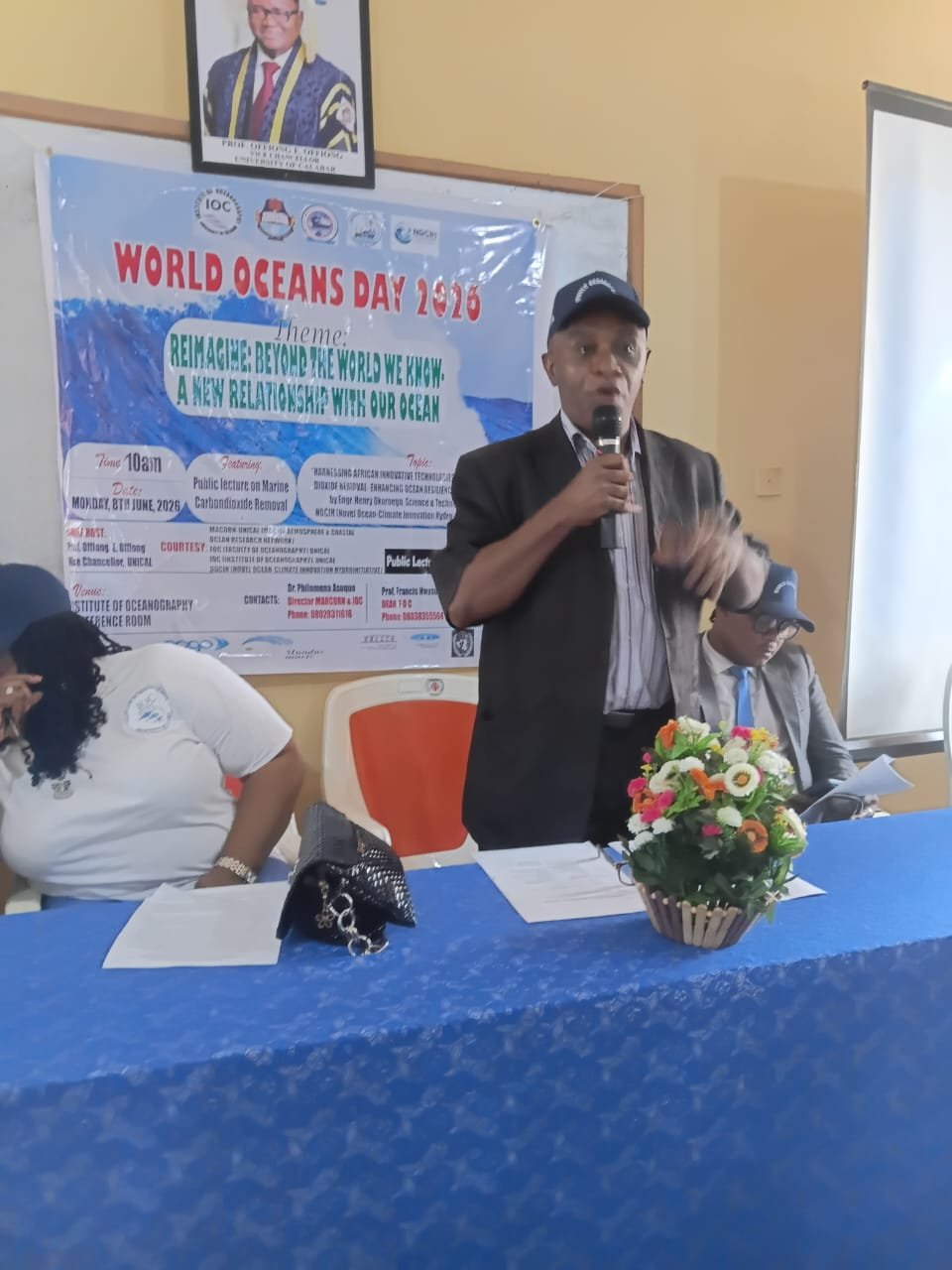
    Dean of the Faculty of Oceanography, University of Calabar (UNICAL), Prof. Francis Nwosu, made the call during the 2026 World Oceans Day celebration organised by the Faculty and Institute of Oceanography.

    The event was themed, “Reimagine: Beyond the World We Know – A New Relationship With Our Ocean.”

    Prof. Nwosu said Nigeria’s ocean resources remain largely untapped despite their enormous potential to drive economic growth, enhance food security and improve the livelihoods of coastal communities.

    He stressed that strategic investments in marine science, research and manpower development would help unlock the nation’s blue economy.

    According to him, World Oceans Day serves as a reminder of the collective responsibility of nations to protect marine ecosystems while harnessing their resources for sustainable development.

    The dean stated that UNICAL is well-positioned to lead marine research and development in Nigeria, but requires adequate funding and modern facilities to fully explore and utilise the country’s vast ocean resources.

    He warned that coastal communities and cities face increasing threats from climate change and environmental degradation, calling for greater investment in conservation efforts to protect lives, livelihoods and marine biodiversity.

    Prof. Nwosu also appealed to the university management to prioritise marine sciences and strengthen student training programmes to maximise opportunities in research, innovation and the emerging blue economy.

    Commending President Bola Ahmed Tinubu for establishing the Federal Ministry of Marine and Blue Economy, he described the move as a strategic recognition of the economic value of Nigeria’s oceans and waterways.

    He noted that the ministry could drive investment, regulation and sustainable exploitation of marine resources if supported with adequate funding and political commitment.

    The oceanography expert lamented that Nigeria has explored less than one per cent of its coastal waters, despite oceans covering about 71 per cent of the earth’s surface.

    He said the country’s maritime domain remains underutilised, with immense untapped potential for economic development and food production.

    Earlier, the Director of the Institute of Oceanography, Dr. Philomena Edet Asuquo, said the theme of this year’s World Oceans Day calls on everyone to rethink not only how we use the ocean but how we value, protect, and connect with it, and to recognize its vital role in sustaining life on earth.
     She noted that in recent times, coastal communities, particularly fishermen, have lamented how rising pollution and dwindling fish stocks are affecting their lives.
     “Their stories remind us that the health of our oceans is not abstract, but deeply tied to human lives, livelihoods, and our shared future,” she said.

    Guest speaker and Science and Technology Manager at Novel Ocean-Climate Innovation Hydro-Initiative, Engr. Henry Okoroego, called on policymakers and stakeholders to place marine ecosystems at the centre of national development planning.

    He said investments in ocean data, clean technology and community-based monitoring would be critical to reversing ocean degradation and strengthening the resilience of coastal communities.

    The event attracted students, academics and other stakeholders, and featured interactive discussions on marine biodiversity, climate change, ocean conservation and career opportunities in the blue economy.


  • Health Week Targets Infants, Introduces HPV Vaccine for Girls in Cross River

    Health Week Targets Infants, Introduces HPV Vaccine for Girls in Cross River

    By BANNERNEWS Reporter, Calabar

    Cross River State has rolled out a series of healthcare interventions as part of the 2026 Maternal, Newborn and Child Health (MNCH) Week, aimed at improving the wellbeing of mothers and children across the state.

    The weeklong campaign, which runs from June 11 to 15, will provide routine immunisation for children aged zero to 15 months, introduce the Human Papillomavirus (HPV) vaccine for nine-year-old girls, and offer multiple micronutrient supplements, iron and folic acid tablets, as well as Sulfadoxine-Pyrimethamine (SP) for malaria prevention in pregnancy.

    Free HIV and Tuberculosis screening, testing and counselling services will also be available during the exercise being coordinated by the Cross River State Primary Health Care Development Agency (CRSPHCDA), the Ministry of Health and development partners.

    Flagging off the programme in Calabar, the Wife of the Governor, Bishop Eyoanwan Bassey Otu, urged parents and caregivers to take advantage of the free services, describing the initiative as a critical investment in the health of families and communities.

    “These interventions are free, safe and designed to protect the health of our families. A healthy child is the foundation of a healthy community, and a healthy mother is the strength of a healthy nation,” she said.

    Mrs Otu noted that the campaign remains one of the most cost-effective public health interventions, reaching mothers and children in all 18 local government areas of the state with essential healthcare services.

    Commissioner for Health, Dr Henry Ayuk, said the government’s strategy of taking healthcare directly to communities had continued to yield positive results. He disclosed that outreach programmes contributed significantly to the state’s estimated 400,000 outpatient visits recorded in 2025, with initiatives supported by the Governor’s Wife playing a major role.

    Director-General of the CRSPHCDA, Dr Vivien Mesembe Otu, said the exercise was designed to tackle preventable health challenges through improved access to healthcare services. She reaffirmed the agency’s commitment to ensuring that no mother, newborn or child is left behind.

    Representatives of the World Health Organization (WHO), UNICEF and the National Primary Health Care Development Agency commended the state government’s support for the programme, while urging greater outreach to hard-to-reach communities. The event featured the symbolic administration of vaccines and presentation of healthcare packs, marking the official commencement of the 2026 MNCH Week across Cross River State.

  • Another Territorial Loss to Cameroon Will Be Too Much Sacrifice by Cross River — PDP Stalwart

    Another Territorial Loss to Cameroon Will Be Too Much Sacrifice by Cross River — PDP Stalwart

    By BANNERNEWS Reporter, Calabar

    A Peoples Democratic Party (PDP) stalwart and aspiring candidate for the Ikom/Boki Federal Constituency seat in the 2027 general elections, Mr. Pius Abang, has warned that Cross River State cannot afford another territorial loss to Cameroon.

    Abang spoke on Thursday while reacting to Wednesday’s reported incursion by Cameroonian soldiers into Danare community in Boki Local Government Area of the state.

    He cautioned that silence and inaction by Nigerian authorities could expose the country to another territorial setback, stressing that Cross River had already made enormous sacrifices through the loss of the Bakassi Peninsula and its associated oil-rich resources.

    According to him, allowing further encroachment on Nigerian territory would amount to a betrayal of communities that have borne the consequences of previous boundary adjustments.

    “No more Cross River land should be lost to negligence. This should not repeat itself,” he said, recalling the ceding of Bakassi and the attendant loss of oil wells to Cameroon and neighbouring Akwa Ibom State.

    Abang called on relevant federal agencies, including border security authorities, the Ministry of Foreign Affairs and the National Boundary Commission, to immediately investigate the reported incursion, engage with Cameroonian authorities and reaffirm Nigeria’s territorial integrity in Danare.

    He maintained that prompt diplomatic and security intervention would prevent further escalation and reassure residents of the affected border community.

    The PDP chieftain also urged President Bola Tinubu and Governor Bassey Otu to treat the matter with urgency, describing it as a national sovereignty issue that demands immediate attention.

    He further called on the National Assembly member representing the area to move a motion that would compel the Federal Government to take decisive action, warning that the continued presence of foreign troops in the area could create fear among residents and undermine Nigeria’s territorial sovereignty.

  • APPRAISING GOVERNOR BASSEY OTU’S THREE YEARS OF TRANSFORMATION

    APPRAISING GOVERNOR BASSEY OTU’S THREE YEARS OF TRANSFORMATION

    By Kingsley Agim

    Three years into the administration of Governor Bassey Edet Otu, one of the most visible and measurable indicators of governance performance in Cross River State is the scale and spread of infrastructure development across the state. Under the People First Agenda, infrastructure has not been treated merely as a collection of construction projects, but as a strategic instrument for economic revival, social inclusion, rural integration, and long-term competitiveness.

    From roads and bridges to electricity, water supply, transportation systems, aviation infrastructure, and border community development, the Otu administration has pursued a coordinated infrastructure agenda aimed at reversing years of decay while laying the groundwork for accelerated industrialization. The result is an infrastructure renaissance that is gradually redefining mobility, productivity, and quality of life across the Southern, Central, and Northern Senatorial Districts.


    Strategic Road Infrastructure

    Perhaps the most visible achievement of the administration lies in the road sector. For decades, inadequate road infrastructure remained a major impediment to commerce, agricultural transportation, security operations, and access to essential services. The administration responded with one of the most ambitious road intervention programmes in the state’s recent history.

    Across the Southern Senatorial District alone, more than 102 kilometres of roads have either been rehabilitated or constructed. Critical urban corridors such as Murtala Mohammed Highway, Marian Road, Parliamentary Extension Road, Esuk Utan Road, and numerous streets across Calabar have undergone significant upgrades, improving traffic flow and reducing transportation bottlenecks within the state capital.

    Beyond Calabar, major road projects such as the Adiabo-Eseku Road in Odukpani and the 28-kilometre Oban-Nsan Road in Akamkpa have enhanced connectivity to rural communities and agricultural zones. These roads are not merely transport routes; they are economic arteries linking farmers to markets, communities to healthcare facilities, and businesses to opportunities.

    In the Central Senatorial District, strategic investments in the Ugep and Ikom road networks, alongside the Mkpani-Agoi Road, have strengthened commercial activities in key economic hubs. Similarly, road construction projects in Ogoja, Yala, and Boki have improved accessibility to previously underserved communities in the Northern Senatorial District.

    The reconstruction of critical bridges, including the Akhreha/Okpoku Bridge and Yellow Duke Mini Bridge, further demonstrates the administration’s commitment to eliminating physical barriers to movement. Collectively, these interventions have reduced travel times, lowered transportation costs, enhanced security mobility, and stimulated economic activities across local government areas.

    Powering conomic Growth Through Energy Infrastructure

    Infrastructure development under Governor Otu has extended beyond roads to one of the most critical enablers of economic growth; which is electricity.

    Recognizing that sustainable development cannot occur without reliable power supply, the administration embarked on extensive rehabilitation and expansion of electricity infrastructure through the Ministry of Power and Renewable Energy and the State Electrification Agency.

    The rehabilitation of key 33kV electricity networks spanning Odukpani, Akamkpa, Akpabuyo, Bakassi, Ikom, Bekwarra, Yala, Ogoja, and Calabar has restored power to numerous communities that had suffered prolonged outages. Multiple transformer substations have also been rehabilitated, upgraded, and newly installed across strategic locations.

    Particularly noteworthy is the intervention at the Adiabo Power Plant. The state’s assumption of operational responsibility for the 26MW facility signals a bold attempt to strengthen local energy generation and reduce dependence on external supply constraints. Combined with the “Operation Light Up Cross River” initiative, these efforts have improved electricity availability for households, businesses, and government institutions.

    The installation of solar-powered systems and hundreds of solar streetlights across Calabar, Ugep, Ikom, and Ogoja demonstrates the administration’s recognition of renewable energy as a critical component of future development. Improved street lighting has enhanced public safety, extended commercial activities into nighttime hours, and strengthened urban aesthetics.

    Equally significant is the state’s move to domesticate the Electricity Act 2023, a policy initiative expected to unlock private investment opportunities in power generation, transmission, and distribution. This legislative foresight positions Cross River to benefit from the evolving electricity market framework in Nigeria.


    Reviving Water Infrastructure and Public Health Outcomes

    Access to clean water remains one of the most important indicators of development. In this regard, the administration inherited a sector characterized by years of neglect, including treatment facilities that had remained non-functional for nearly a decade.

    The rehabilitation of the Calabar Water Treatment Plant, which had been dormant for eight years, represents one of the administration’s most consequential interventions. By restoring pumps, compressors, power systems, and treatment equipment, the government successfully revived water production and distribution services to Calabar and adjoining communities.

    Beyond the state capital, treatment facilities in Itigidi, Obubra, Ikom, Ogoja, and Okpoma were rehabilitated and brought back into operation. Together, these interventions facilitated the supply of over 64,700 cubic metres of treated water between late 2023 and early 2025.

    At the rural level, the efforts of RUWATSSA have significantly expanded access to potable water through the rehabilitation of 151 hand pump boreholes and construction of solar-powered boreholes across multiple local government areas. These interventions are particularly important in reducing the prevalence of water-borne diseases and improving living conditions in underserved communities.

    The administration’s sanitation initiatives have also yielded measurable outcomes. Through Community-Led Total Sanitation programmes, more than 10,000 household toilets have reportedly been constructed, while gender-responsive sanitation facilities have improved dignity, safety, and public health standards, particularly for women and girls.


    Sustainable Transportation

    One of the defining features of the Otu administration’s infrastructure agenda is its embrace of sustainable transportation.

    While many subnational governments remain focused solely on conventional transport systems, Cross River has positioned itself among the states pioneering green mobility solutions. The establishment of Compressed Natural Gas conversion infrastructure and the procurement of electric motorcycles, electric vehicles, and electric tricycles reflect a deliberate effort to align transportation development with emerging global sustainability trends.

    Beyond environmental benefits, these investments are expected to lower transportation costs, reduce dependence on fossil fuels, and improve energy efficiency. They also signal Cross River’s readiness to participate in Nigeria’s broader energy transition agenda.

    The conduct of transportation prefeasibility studies across major urban centres further demonstrates a data-driven approach to infrastructure planning, ensuring future investments are guided by evidence rather than assumptions.


    Industrialization

    A notable characteristic of the administration’s infrastructure strategy is its focus on projects capable of generating long-term economic transformation.

    The facilitation of the Bakassi Deep Seaport project stands out as one such initiative. Once operational, the seaport has the potential to reposition Cross River as a major logistics, trade, and industrial hub within the Gulf of Guinea region. Beyond maritime commerce, the project is expected to stimulate manufacturing, warehousing, logistics services, and export-oriented industries.

    Similarly, ongoing investments in aviation infrastructure point toward a future-oriented development strategy. Significant progress recorded at the Obudu International Passenger and Cargo Airport, including runway construction, terminal development, apron construction, control tower installation, and safety infrastructure, suggests a deliberate effort to expand connectivity and unlock tourism, cargo movement, and investment opportunities.

    The acquisition of additional aircraft for Cally Air and the securing of operational licensing further strengthen the state’s aviation ecosystem and position it as a growing player within Nigeria’s regional air transport network.

    Border Communities

    An important but often overlooked aspect of the administration’s infrastructure achievements is its attention to border communities.

    Through targeted interventions by the Border Communities Development Commission, projects such as health centres, classroom blocks, solar-powered water facilities, trans-border markets, police infrastructure, and skills acquisition centres have brought government presence closer to historically underserved populations.

    These investments are helping to reduce geographical inequalities, strengthen border security, improve access to social services, and stimulate local economic activities in frontier communities.

    The true measure of infrastructure development is not the number of kilometres constructed or transformers installed, but the extent to which such investments improve people’s lives.

    Viewed through this lens, Governor Bassey Otu’s infrastructure agenda represents more than physical development. It is an attempt to rebuild the foundations upon which economic prosperity, social stability, and human development depend. Roads are connecting farmers to markets; electricity is supporting businesses and improving productivity; water projects are enhancing public health; transportation reforms are preparing the state for a greener future; and strategic investments in aviation and maritime infrastructure are opening new frontiers for economic growth.

    As the administration marks three years in office, the Infrastructure Cluster stands as one of the strongest pillars of the People First Agenda. The cumulative impact of these interventions suggests a government not only focused on addressing immediate deficits but also committed to positioning Cross River State for sustained growth and competitiveness in the years ahead.

    In many respects, the infrastructure story of the past three years is the story of a state reconnecting its communities, restoring critical services, and building the physical foundations for a more prosperous future.

  • Otu Engenders Peace Amongst Political Parties, Pays Subventions 

    Otu Engenders Peace Amongst Political Parties, Pays Subventions 

    By BANNERNEWS Reporter, Calabar

    The prevalent peace amongst political parties in Cross River State is as a result of constant payment of subventions by Governor Bassey Otu to the Inter-party.

    This was disclosed by Nkoyo Otu , the special adviser on inter-party affairs to the governor while briefing journalists when the Forum of Special Advisers listed achievements of the Otu administration.

    “Gov Otu has engendered peace and harmony amongst political parties in the state. This is the first time this is happening.

    “The governor regularly pays subventions to the political parties. This has contributed to prevalent peace amongst politicians and their parties”, she said.

    She further disclosed that Otu has built and donated a splendid secretariat to Inter-Party Advisory Council, IPAC.

    “The body did not have its own secretariat before now. They operated from individual politician’s offices or rented apartment. But today, they’ve befitting edifice to their name. This is courtesy of Governor Bassey Otu”, she said.

    She disclosed further that unlike other administrations, there is no litigations against Otu as a person or his government by political parties.

  • Army Orders Brigade Commander to Meet Cameroonian Counterpart Over Border Incursion in Cross River

    Army Orders Brigade Commander to Meet Cameroonian Counterpart Over Border Incursion in Cross River

    By BANNERNEWS Reporter, Calabar

    Nigerian Army authorities have directed the Commander of the 13 Brigade, Calabar, to immediately engage his Cameroonian counterpart following the recent incursion of Cameroonian soldiers into Danare community in Boki Local Government Area of Cross River State.

    The directive comes after armed Cameroonian troops entered the border community on Wednesday, triggering tension as local youths resisted the incursion. The confrontation reportedly led to sporadic gunfire by the foreign soldiers before they eventually withdrew.

    In a statement issued by the Acting Deputy Director, Army Public Relations, 82 Division, Lt. Col. Olabisi Ayeni, the Army said the General Officer Commanding (GOC) 82 Division ordered the engagement as part of efforts to strengthen border coordination and prevent a recurrence.

    “The Division noted concerns arising from the unauthorised entry of personnel of the Cameroonian Armed Forces,” Ayeni stated.

    He explained that, in line with existing diplomatic and military cooperation arrangements, the GOC directed the 13 Brigade Commander to meet with his Cameroonian counterpart to clarify operational procedures along the border and reinforce confidence-building measures between both countries.

    According to the Army, troops responded promptly after receiving reports of the foreign military presence and immediately contacted relevant Cameroonian authorities, leading to the withdrawal of the soldiers from Nigerian territory without further escalation.

    Ayeni disclosed that preliminary findings indicated that the incident was linked to a dispute over the collection of levies on farmland situated between Danare community in Nigeria and Dadi community in Cameroon.

    The Army assured residents that the situation had been brought under control and that troops remained on alert to monitor activities along the border. It reiterated its commitment to safeguarding Nigeria’s territorial integrity and protecting communities within its area of responsibility.

    Residents of Danare and neighbouring communities were urged to remain calm, continue their lawful activities and avoid spreading unverified information capable of heightening tensions.

    The latest incident revives concerns over recurring cross-border security challenges in Cross River.

    In 2013, Cameroonian troops reportedly entered Basua community while pursuing separatist fighters, prompting the Nigerian Army to establish a Forward Operating Base in the area.

    In 2025, armed Ambazonian rebels occupied Belegete community in Obanliku Local Government Area for about two weeks, killing the community head, burning houses and hoisting their flag before being dislodged.

  • CAMEROONIAN SOLDIERS STORM CROSS RIVER COMMUNITY, SHOOT SPORADICALLY

    CAMEROONIAN SOLDIERS STORM CROSS RIVER COMMUNITY, SHOOT SPORADICALLY

    By BANNERNEWS Reporter, Calabar
    Tension engulfed Danare community in Boki Local Government Area of Cross River State on Wednesday morning as heavily armed Cameroonian soldiers reportedly entered the border settlement and fired warning shots while confronting local youths who challenged their presence.
    The incident, captured in videos circulated by residents, showed scores of youths and women blocking the advance of the foreign troops and insisting that Danare remained Nigerian territory. The soldiers were seen carrying sophisticated weapons and were heard ordering residents to stop recording them.
    Eyewitnesses said the confrontation nearly degenerated into violence when the soldiers, said to be more than 50 in number, fired several shots into the air in an apparent bid to disperse the crowd and force their way through.
    Former member of the Cross River State House of Assembly, Cletus Obun, confirmed the development, describing it as another episode in the long-running border dispute between communities in the area and neighbouring Cameroon.


    According to Obun, the soldiers advanced into Danare I near a Catholic Church along the road leading to Budum before they were confronted by local youths.
    “The Cameroonian soldiers shot several times to scare away the youths who blocked their further advance into Nigerian territory,” he said.
    Obun blamed the recurring incursions on what he described as inadequate protection of Nigeria’s border communities, alleging that Cameroon had continued to challenge aspects of the United Nations-backed boundary demarcation arising from the International Court of Justice ruling on the Bakassi Peninsula.
    He recalled that similar attempts were made in 2013 during the border demarcation exercise, adding that repeated appeals by community leaders, including former Senate Leader Victor Ndoma-Egba, for stronger security presence in the area had not yielded the desired response.
    Reacting to the incident, the spokesman of the 13 Brigade of the Nigerian Army, Major Yemi Sokoya, said military authorities were aware of the development and would issue an official statement after receiving details from personnel on ground.
    Also reacting, Chairman of Boki Local Government Area, Mrs Beatrice Etta Nyiam, confirmed receiving reports from residents concerning the alleged unauthorized entry of Cameroonian military personnel into Danare community.
    She assured residents that the matter was receiving the attention of relevant security agencies and government authorities, urging the people to remain calm, law-abiding and avoid actions capable of escalating tensions in the border area.

  • Security Forces Repel Bandits’ Attack in Zamfara, Recover 12 Motorcycles

    Security Forces Repel Bandits’ Attack in Zamfara, Recover 12 Motorcycles

    By BANNERNEWS Reporter, Gusau

    A joint security team in Zamfara State has repelled an attack by armed bandits along Gadar Manya in Anka Local Government Area during a coordinated anti-banditry patrol.

    The team, comprising operatives of the VCRU, ZFS, Mobile Police Force, and Civil Security Volunteers, reportedly encountered the armed men as they attempted to cross the highway.

    According to a statement by the Police Public Relations Officer, DSP Yazid Abubakar, the bandits opened fire upon sighting the operatives, triggering a fierce exchange that lasted about two hours.

    He said the security personnel responded with superior firepower, forcing the attackers to flee into the bush with suspected gunshot wounds, abandoning two motorcycles at the scene.

    “The operatives responded effectively, forcing the criminals to retreat into the bush with suspected gunshot wounds and abandoned two motorcycles,” DSP Yazid stated.

    He added that the recovery brings the total number of motorcycles seized during recent anti-banditry operations in the area to 12.

    The police spokesperson further disclosed that efforts are ongoing to track down and arrest the fleeing suspects.

    He reaffirmed the command’s commitment to sustaining the fight against banditry and protecting lives and property across the state, while urging residents to continue providing timely intelligence to security agencies.

  • 30,000 Retired Police Officers Threaten Nationwide Protest Over Exit from CPS

    30,000 Retired Police Officers Threaten Nationwide Protest Over Exit from CPS

    By BANNERNEWS Reporter, Akure

    Over 30,000 retired police officers have called on President Bola Ahmed Tinubu to sign the Police Exit Bill, warning that they may embark on nationwide peaceful protests if their demands are not met before June 22, 2026.

    The appeal was made on Tuesday in Akure, Ondo State, during a press briefing by the National Coordinator of the Police Retired Officers Forum of Nigeria (PROF), CSP Raphael Irowainu (Rtd).

    The forum described the proposed legislation as a critical security reform, not merely a welfare demand, insisting that better pension arrangements are key to improving policing efficiency and national security.

    The bill, which seeks to remove the Nigeria Police Force from the Contributory Pension Scheme (CPS), was passed by the National Assembly in December 2025 and forwarded to the President in March 2026 for assent.

    The retirees are demanding presidential approval of the bill, full withdrawal of the police from the CPS, migration to a Defined Benefit Pension Scheme, creation of a Police Pension Board, and payment of all outstanding pension arrears and accrued rights.

    While expressing optimism that President Tinubu would approve the legislation, the group warned that failure to act within the stipulated timeframe would trigger renewed nationwide peaceful protests.

    “Our position remains unchanged, unwavering and non-negotiable — total exit from PENCOM and restoration of pension justice for retired police officers,” Irowainu said.

    He argued that officers’ welfare is directly tied to morale, discipline, and operational effectiveness, noting that insecurity in retirement weakens performance during active service.

    “This is not merely a welfare reform; it is a national security investment whose impact will be felt across every community in the country,” he added.

    Irowainu maintained that financial security after service encourages integrity in service and improves crime-fighting capacity and intelligence operations.

    He further argued that exempting the police from the CPS would align the force with other security agencies such as the Armed Forces, DSS, NIA, and EFCC, which operate separate pension arrangements.

    According to him, such parity would strengthen institutional morale, improve cooperation among security agencies, and reinforce national appreciation for policing.

    The forum said President Tinubu’s decision on the bill would define his legacy in security sector reform, recalling his past commitment to police welfare as Governor of Lagos State.

    It added that approving the bill would “cement his place in history” as a leader who prioritised national security by securing the welfare of the police.

    The retirees insisted that the proposed exit from the CPS would enhance professionalism, reduce corruption risks, and rebuild public trust in law enforcement.

    They also lamented poor pension conditions, saying many retired officers continue to face severe financial hardship after decades of service to the nation.