By BANNERNEWS Reporter, Calabar
The Nigerian Bar Association (NBA), Ikom Branch, Cross River State, in collaboration with judges, lawyers, businesses, communities and other public-spirited individuals, has raised and spent over N18 million to renovate the High Court II complex in Ikom.
This followed their alleged frustration by years of government neglect of judicial infrastructure in parts of the State,
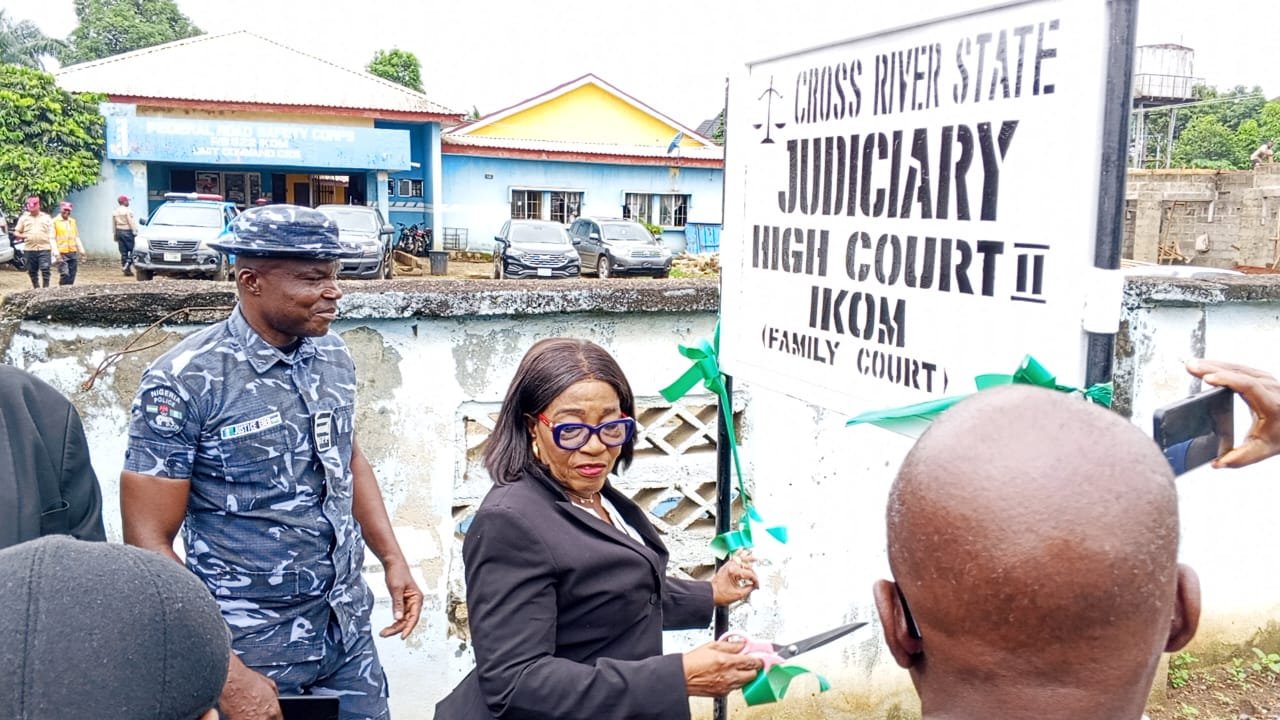
The refurbished court complex was commissioned on Saturday by the Chief Judge of Cross River State, Justice Akon Bassey Ikpeme, who described the initiative as a remarkable demonstration of commitment to the justice sector. The project was executed through voluntary contributions after repeated appeals for government intervention reportedly yielded little result.
The renovation included the installation of a new roof, ceilings, modern glass windows, furniture, solar-powered electricity, a public address system, fresh painting, tiling of the court hall and the refurbishment of the judge’s chambers.
Speaking at the commissioning, Justice Ikpeme commended the NBA Ikom Branch for taking the initiative to restore the court to a befitting standard.
“The last time I visited this court, I left feeling depressed by its condition. Today, the story is different. What I have seen is wonderful. I commend the NBA and everyone who contributed to this project. You have set a pace for the entire state,” she said.
She urged stakeholders to safeguard the facility against vandalism, adding that efforts would be made to secure government approval for security personnel to protect the premises.
Chairman of the NBA, Ikom Branch, Tah Edwardson Offre Esq., said the association had for years carried out minor repairs on the facility, but the intervention proved inadequate, prompting members to embark on a comprehensive renovation through community support.
He recalled that the association had consistently drawn attention to the deplorable condition of court facilities during successive legal year ceremonies, noting that several court buildings across the state had deteriorated beyond acceptable standards.
According to him, High Court II in Ikom, Magistrate Courts I and II, as well as the Okundi Magistrate Court destroyed by a rainstorm over 15 years ago, remain among the most affected. He added that Magistrate Courts II and III were damaged after a large tree fell on the building, while Magistrate Court I was gutted by fire in April this year.
“With the approval of the Chief Judge, the Presiding Judge of High Court II, Justice Emmanuel Ubua, the NBA and well-meaning members of the public mobilised resources to undertake this project, which cost over N18 million,” Offre said.
Justice Edet Kufre of High Court I applauded the effort, describing the project as evidence of what determination and collective sacrifice could achieve. “I know what it takes to convince people to contribute to a project like this. The building speaks for itself. It is an excellent job,” he remarked.
Presiding Judge of High Court II, Justice Emmanuel Ubua, expressed gratitude to the Chief Judge for approving the project and to members of the NBA and the Ikom community for supporting the initiative. He recalled that the court building was in such a deplorable condition that dispensing justice had become increasingly difficult.
“A court is meant to be a sanctuary where people come with confidence that justice will be served. What we met here was heartbreaking—the roof leaked badly and the walls were falling apart. We hope this project will challenge the government to realise that restoring judicial infrastructure is both necessary and achievable,” he said.
The commissioning also became a platform for renewed calls on the Cross River State Government to prioritise investment in judicial infrastructure. Lawyers and other stakeholders lamented that court facilities across the state—from Calabar to Obudu—remain in poor condition, despite the judiciary being a critical arm of government.
Many participants compared the situation in Cross River with neighbouring states such as Ebonyi, Rivers and Benue, where they said governments have made significant investments in modern court infrastructure. The dominant message at the event was that while the legal community had demonstrated that collective action could deliver results, government must not abdicate its constitutional responsibility to provide adequate facilities for the administration of justice.